
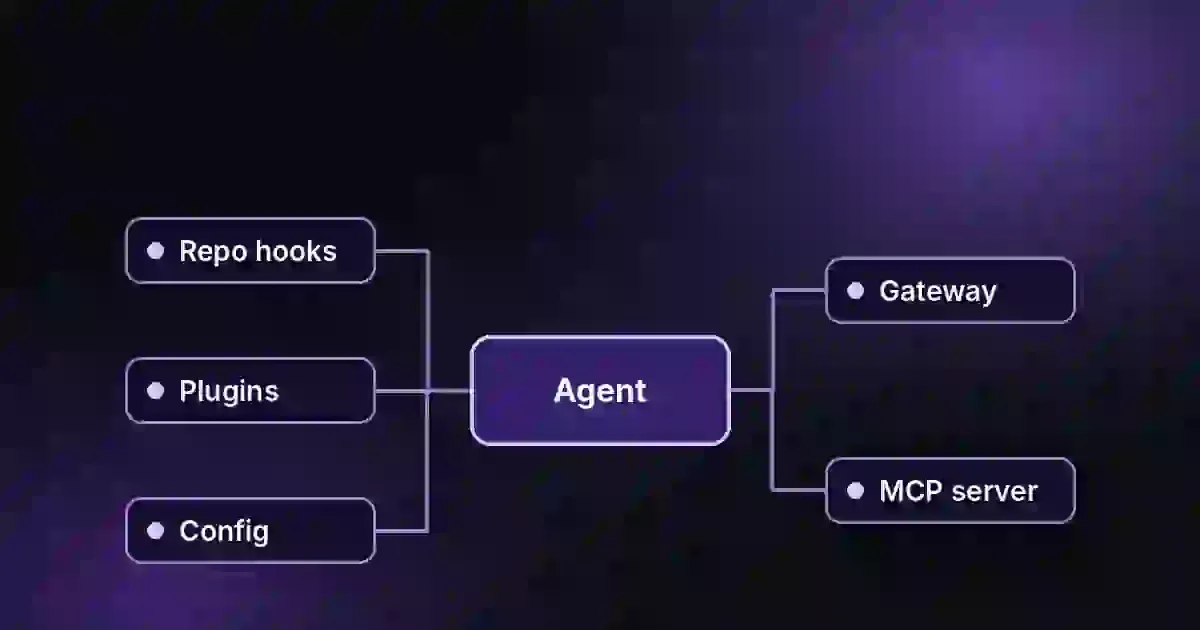
Coding agents decide what to trust largely by where something sits: a settings file inside a repository, a gateway on the network path, an extension in a plugin folder, a metadata URL handed over by an MCP server, a config file a setup script rewrote. Six pieces of research and incident reporting from October and early November 2026 each show a different version of that mistake. Taken together they say that a developer-environment pentest has to inspect those locations directly, because none of the sources we read assigns a CVE, so vulnerability scanners have nothing to flag.
TL;DR
- Six independent write-ups describe agents or their harnesses trusting a location (repo config, traffic path, extension, server-supplied URL, local config) instead of verified provenance.
- Most are lab or proof-of-concept results. Only the relay-installer and "prompt adware" reports describe activity seen in the wild, and neither shows data theft.
- Where vendors responded, the answers were "informative", "outside the threat model" or "not a vulnerability". None of the sources we read reports a CVE for these cases.
- Vendor documentation is explicit about some of these boundaries, including a non-interactive mode that skips the trust prompt, so testers can check them against the docs.
- Test the locations, not just the model: extension provenance, what sits on the model path, which processes skip trust prompts, and which config keys redirect endpoints or widen the sandbox.
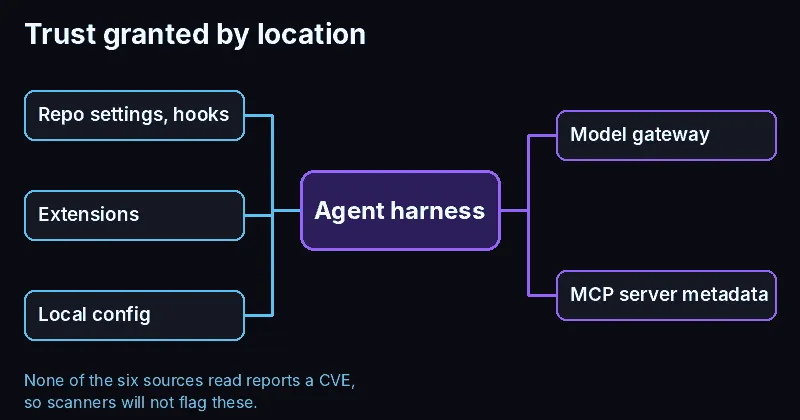
The pattern in six findings
We read each of the primary sources below. Where we could not read a figure or video, we say so. None of the results has been independently replicated, as far as we found.
A modified extension, a trigger phrase, no visible tool call
On 30 October 2026, the EU's computer emergency response team for its institutions (CERT-EU) published lab work on backdoored agent harnesses. The team modified local copies of two legitimate third-party packages, one for the Pi agent (1.3.0) and one for Claude Code (2.1.304), to run a credential-collection routine when an ordinary phrase appeared in user input. In both cases the payload ran without the model starting it, and the agent showed no visible tool call. The authors report that restrictions on the agent's file-read tools did not apply to files the plugin's own code read, and that controls inspecting model-generated tool calls did not intercept the operation in the configurations they tested. This was an isolated lab with test credentials, and the post says no public releases were modified. The post also floats, as an untested hypothesis, that a trigger inside a tool result could do the same.
A party on the model path can forge approved actions
On 22 October, HiddenLayer described hijacking coding agents in transit. The threat model needs control of a point on the model-traffic path, for example a compromised gateway or a malicious inference wrapper. From there, the authors say they could identify the harness from request headers, infer approval modes from tool-call timing, and inject tool calls that fit permissions the user had already granted. They demonstrate two cases (a manual-approval mode with auto-approved edits, and an approved command prefix) and describe, without testing, swapping a dependency name for a lookalike. The post does not state its test environment or any vendor response, and we could not watch the embedded demo videos. Its central point is that a sandbox or approval prompt does not prove that a tool call came from the intended model.
A child session that skipped the trust prompt
Straiker's Session Inception write-up (8 October) describes a proof of concept on a test repository. A parent Claude Code session, asked to clone and summarise a repository, ran the Claude command-line interface from its shell. That started a child session inside the repository, which loaded the repository's settings and ran a session-start hook without the workspace-trust confirmation that another path shows. Straiker reports it filed the issue on 17 September 2026 and that Anthropic closed it as Informative, on the position that trust in repository settings is part of the user's own workspace-trust decision. The page gives no affected or fixed versions.
A server-supplied URL that reached a shell
Pillar Security's opencode write-up concerns the remote Model Context Protocol (MCP) OAuth flow. A server's discovery response supplies an authorization endpoint, and on Windows and WSL the browser-launch helper passed it to PowerShell without proper escaping. Pillar lists versions 1.0.137 through 1.18.32 as affected and 1.18.33 as the fix, and says macOS and Linux are not affected. It reports the vendor shipped the fix as a refactor, said a malicious remote MCP server is outside its threat model, and that no CVE or advisory was issued. The page's own dates conflict (a 19 October byline against a 4 October entry in its timeline), so we cite it only as October 2026. The CVSS score of 9.8 in the post is the researchers' proposal, not an official score.
Config rewritten by relay installers, and instructions rewritten by a bundle
Two reports cover tampering in the wild. Symantec (29 October) saw about a dozen organisations, mostly in mainland China, where users installed genuine Codex or Claude Code packages and then ran a one-line setup script from a lookalike domain. The script set the sandbox mode to full access, pointed the base URL at a relay and disabled telemetry. Symantec found no trojanised client and no evidence the operator abused the access, and states this is not a vulnerability in either tool. Check Point Research (3 November) analysed a public jailbreak bundle that writes an advert for an LLM gateway into the agent's global instruction files. It found no evidence linking the bundle's author to cybercrime or showing the gateway to be malicious. In Check Point's test of the Claude Code variant, the model flagged the injected advert as a prompt-injection attempt.
The six findings side by side
| Source | Type of evidence | Vendor response, as reported | CVE |
|---|---|---|---|
| CERT-EU | Lab only | None described | None mentioned |
| HiddenLayer | Demonstration, test environment not stated | None described | None mentioned |
| Straiker | Proof of concept | Closed as Informative | None mentioned |
| Pillar (opencode) | Proof of concept | Outside threat model; fixed in 1.18.33 | None issued, per Pillar |
| Symantec | In the wild, about a dozen organisations | Not a vulnerability, per Symantec | Not applicable |
| Check Point | In the wild, one bundle | None described | Not applicable |
What the vendor documentation says about the boundary
The Claude Code documentation is specific enough to test against. Its hooks page says Claude Code checks workspace trust before running a hook from a settings file, but that a non-interactive run (the -p flag or the SDK) never shows the dialog and treats the folder as trusted. Its permissions page tabulates what is used before trust: hooks in settings files and helper commands are used even when only a parent folder was trusted, while project allow rules are held until the dialog is accepted. The security page concedes that no system is immune and that the user is responsible for reviewing commands. We have not tested whether the Straiker path corresponds to any of these documented behaviours, so we do not claim it does.
The MCP specification covers the OAuth case. The security best practices page (draft, undated) says clients must allow only http and https authorization URLs and must not open them through a shell, and it warns that discovery URLs supplied by a server can be abused for server-side request forgery (SSRF). The authorization page makes protected-resource-metadata discovery a requirement, which is exactly the server-supplied trust the first page warns about. Pillar also notes that scheme checks alone would not have blocked its case.
A test list for developer environments
Based on these sources, we would add the following to the scope of a developer-environment assessment, on systems you own or are authorised to test:
- Extensions and plugins. Inventory them, check pinning and update review, and treat each as executable code. Confirm that your file-access and tool-call controls apply to plugin code, not just to the model's calls, as CERT-EU recommends.
- The model path. Identify every gateway, proxy and wrapper between the agent and the model, check that each is authenticated and owned, and check that approved command prefixes cannot be abused.
- Process inheritance. Find which launch modes (interactive, non-interactive, SDK, child sessions) show trust prompts, and which load repository hooks regardless.
- Server-supplied fields. For MCP clients, treat discovery and authorization metadata as untrusted input, and check installed versions of clients directly, since no CVE exists to drive an alert.
- Configuration drift. Alert on changes to base-URL variables, sandbox mode, user-scope API keys, telemetry settings and global instruction files, which are the indicators Symantec and Check Point describe.
This extends, and does not replace, the config-file checks in our earlier piece on repo agent and editor config as an execution surface. For teams in India, CERT-In's guidelines list tool invocation and autonomy as factors that raise a system's audit tier; see our note on CERT-In's tiered AI audit scope.
The PentStark view
This section is opinion. The shared root cause across these six items is our own synthesis; none of the sources claims it. We think it is a useful way to organise testing, because it shifts attention from "can the model be tricked" to "what does the harness believe without checking". We would also hedge: the strongest results are lab demonstrations with preconditions (a modified package installed, a compromised gateway, a vulnerable Windows client), and the in-the-wild cases show configuration abuse, not demonstrated harm. The absence of CVEs is also an inference-heavy point. It does mean scanners will not report these cases, but we have not checked whether identifiers will be assigned later. Vendors may reasonably say that trusting a repository or a server is the user's decision; the practical answer for security teams is to make that decision visible and reviewable, not to assume it was made.
Limits of this post
We ran no code and tested nothing in a sandbox, so this post contains no code and no claim of our own reproduction. The diagram and table were made by us from the cited reports and summarise them; they are not original data. We did not view images or videos on the cited pages. Vendor fix statuses are as reported by the researchers. Several figures in the sources (download counts, user numbers, repository counts) come from unstated or vendor provenance, and we have not repeated them.
References
- CERT-EU: Beyond the model, backdoors in AI agent harnesses, 30 October 2026
- HiddenLayer: hijacking coding agents in transit, 22 October 2026
- Straiker: Session Inception, 8 October 2026
- Pillar Security: Remote code execution in opencode via MCP OAuth, October 2026
- Symantec: Unauthorized AI relays, 29 October 2026
- Check Point Research: Prompt adware hidden in jailbreak bundles, 3 November 2026
- Claude Code documentation: hooks
- Claude Code documentation: permissions
- Claude Code documentation: security
- MCP specification (draft): security best practices
- MCP specification (draft): authorization
Last verified: 2026-11-10